
How Proteins Help Switch Genes On and Off, And Why It Matters for Development and Health
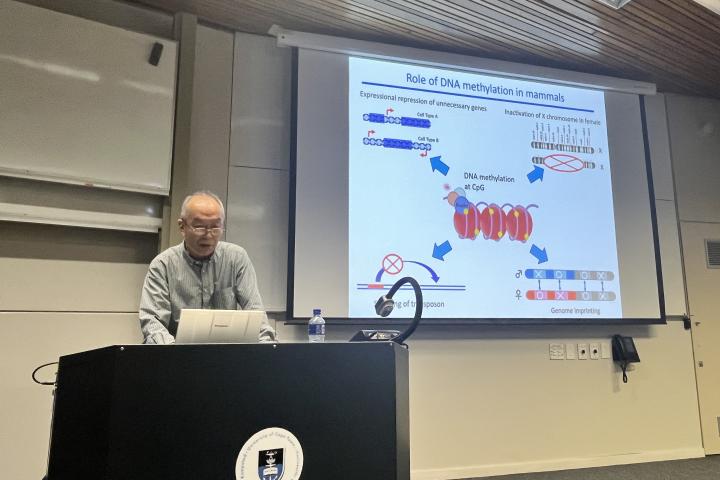
How do cells decide which genes to turn on, which to silence, and when to change their minds? This fundamental question was at the heart of a recent seminar by Dr Suzuki, Team Leader of the Laboratory for Cellular Function Conversion Technology, who shared new insights into how proteins called transcription factors help shape our DNA’s behaviour with important implications for development, cancer, and infection.
The basics: genes need instructions
Although every cell in the body contains the same DNA, not all genes are active all the time. One key way cells control this is through DNA methylation which are small chemical tags that act like switches, telling genes to stay on or off. Removing these tags, a process known as DNA demethylation, is crucial during normal development, when cells change identity, but it can also go wrong in diseases such as cancer.
Scientists have known that certain transcription factors, like proteins that bind to permissive heterochromatin (a special state of DNA) and control gene activity, can help remove these methylation tags. However, only a handful of these proteins had been identified, leaving a big unanswered question: how many transcription factors can do this, and what makes them special?
Finding the hidden features
Dr Suzuki’s team took a fresh approach. They focused on parts of transcription factors known as intrinsically disordered regions (IDRs). Unlike most proteins, these regions do not fold into neat, fixed shapes. Instead, they remain flexible, a feature that turns out to be surprisingly powerful.
By studying modified versions of two well-known transcription factors, RUNX1 and SPI1, the researchers showed that DNA-demethylation-promoting activity depends on having a long, flexible disordered region. When they examined other transcription factors already known to remove methylation, they found the same pattern: at least one of these flexible regions was always doing the work.
Teaching a computer to spot gene-switching proteins
To see how widespread this ability might be, Dr Suzuki’s group turned to machine learning. They trained a computer model to recognise the chemical “fingerprints” of disordered regions that can promote DNA methylation.
The model learned from dozens of known examples, analysing the chemical properties of these protein regions, including how strongly they repel or attract water (often described as "oily" or "water‑loving") and whether they carry an overall positive or negative electrical charge, both of which influence how proteins interact with DNA and other molecules. Four features turned out to be especially important: aromaticity (the presence of ring-shaped chemical groups), aliphatic index (a measure linked to protein stability), fractional charge ratio (the balance of positive and negative charge), and side chain hydrophobic density (how strongly parts of the protein avoid water). Using these, the model became remarkably good at predicting which proteins were likely to associate with demethylation activity.
A much bigger picture emerges
When the researchers applied the model to all known human transcription factors, the results were striking. Hundreds of proteins, far more than previously expected, were predicted to be capable of helping remove DNA methylation marks.
Many of these proteins are involved in shaping the body during early development, such as guiding how tissues and organs form. Others are linked to certain cancers, suggesting that mistakes in this system may contribute to disease.
Why this matters
This research offers a new way of understanding how cells actively reshape their genetic instructions, rather than simply following a fixed program. By identifying common features that allow transcription factors to control DNA methylation, Dr Suzuki’s work opens the door to discovering new regulators of gene activity.
In the long term, these insights could help scientists better understand developmental disorders, cancer, and infections and potentially guide new strategies for diagnosing or treating diseases where gene regulation goes awry.
About the speaker
Dr Suzuki earned his PhD in Pharmacology from Kyoto University and established his research group in 1998. He previously served as Deputy Project Director and Group Director of the Omics Science Centre at the RIKEN Yokohama Institute in Japan. He is currently serving as a Team Director at the RIKEN Center for Integrative Medical Sciences. His research focuses on understanding how genes are regulated and how disruptions in DNA methylation contribute to disease.